
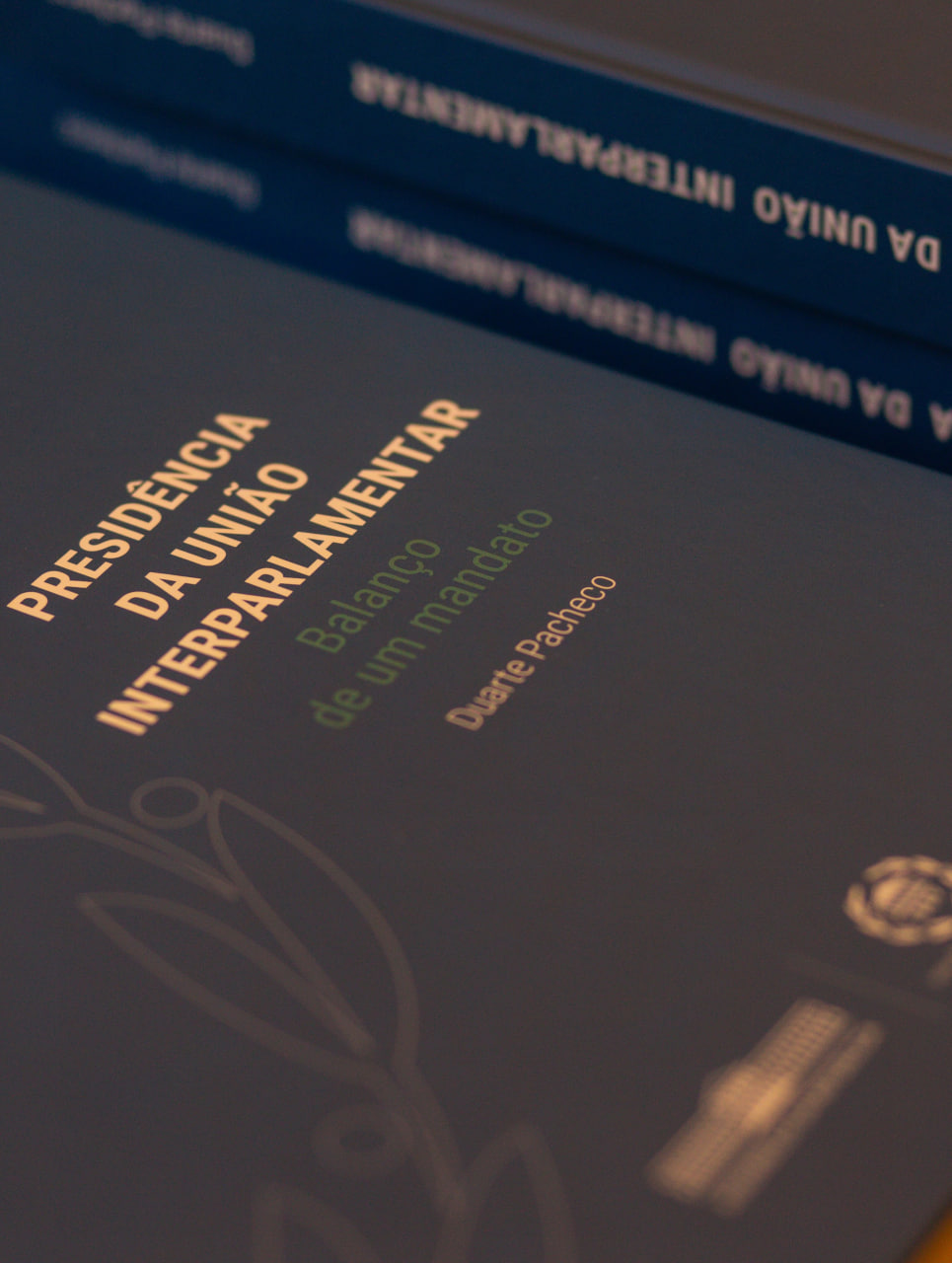
“Those three years were intense, marked by global challenges.”[1]
With this concise observation in the introductory part of Presidência da União Interparlamentar. Balanço de um mandato, Duarte Pacheco identifies the historical setting against which his presidency of the Inter-Parliamentary Union from 2020 to 2023 must be understood. The phrase is more than a retrospective description. It provides an interpretative key to a volume that documents a period in which international parliamentarism was confronted simultaneously by the COVID-19 pandemic, armed conflicts, intensified migration, democratic setbacks, terrorism, the mounting consequences of climate change and a broader crisis of multilateral institutions.
Yet the book also records the gradual restoration of parliamentary presence: from the Fifth World Conference of Speakers of Parliament in Vienna in September 2021 to the 143rd IPU Assembly in Madrid later that year, followed by major Assemblies in Indonesia, Rwanda, Bahrain and Angola. In this sense, Pacheco’s mandate can be read as a movement from enforced institutional distance to the recovery and subsequent intensification of face-to-face parliamentary diplomacy.
Published in Portuguese, English and French, the volume is itself international in form as well as in subject. Its trilingual presentation makes the record accessible to a wider parliamentary readership and reflects the multilingual character of the international community whose activities it documents.
The book’s extensive photographic record is equally significant. The photographs of assemblies, bilateral meetings, international missions and encounters with political, parliamentary and other public figures are more than illustrations accompanying the written narrative. They constitute a visual archive of the mandate in their own right. In doing so, they underline an important dimension of parliamentary diplomacy that institutional documents can sometimes obscure: international cooperation is conducted not by abstract institutions alone, but by people who meet, listen, negotiate and gradually establish relationships of trust.
A presidency born in exceptional circumstances
The circumstances of D. Pacheco’s election already anticipated the unusual character of his mandate. In March 2020, at the height of the COVID-19 crisis, the Portuguese Parliament presented his candidacy for the Presidency of the IPU. Travel restrictions and the impossibility of conventional political campaigning meant that the entire electoral process had to be adapted to virtual conditions.
The presidential election of 3 November 2020 was itself unprecedented in IPU history. It was conducted virtually while safeguarding the secrecy of the ballot. With 90 per cent of the electoral college participating, Pacheco was elected in the first round with 222 votes, representing 57 per cent of votes cast.
This episode is more than an interesting institutional detail. It establishes one of the themes that runs throughout the book: democratic institutions must be capable of adapting to crisis without abandoning the principles that give them legitimacy.
The recovery of in-person parliamentary diplomacy was itself a significant part of this institutional adaptation. The Fifth World Conference of Speakers of Parliament in Vienna in 2021 marked one of the first major opportunities for the global parliamentary community to meet physically after the pandemic disruption. Later that year, the 143rd IPU Assembly in Madrid consolidated that return to direct dialogue. The importance of these meetings was therefore not only substantive; their physical occurrence was itself a statement about the resilience of multilateral parliamentarism.
The pandemic required parliaments to change how they functioned, but it also demonstrated why representative institutions remained indispensable.
The pandemic as a test of parliamentarism
Some of the strongest pages of the volume concern the parliamentary response to COVID-19. The President’s summary of the 142nd IPU Assembly, held virtually in May 2021 under the theme Overcoming the pandemic today and building a better tomorrow: the role of parliaments, captures the breadth of this approach. In retrospect, the 142nd Assembly can be seen as the first stage in a broader progression of D. Pacheco’s mandate: from maintaining democratic and parliamentary functionality during an emergency, to rebuilding direct parliamentary dialogue, and ultimately to placing climate action, equality, peaceful coexistence and institutional strength at the centre of the IPU agenda.
The crisis was treated not simply as a public-health emergency but as a democratic, economic, social and human-rights challenge.
D. Pacheco and the IPU emphasized that vaccines had to be understood as a public good. Parliaments were urged to resist vaccine nationalism, promote equitable distribution and ensure that vulnerable groups including refugees, asylum seekers, displaced persons, persons with disabilities and populations in areas affected by conflict were not excluded.
This was an important conception of parliamentary responsibility. Public health, in this view, could not be separated from equality and solidarity. The same pages also reveal a concern with the impact of emergency government on democracy.
The pandemic placed enormous pressure on democratic institutions. Freedom of expression, access to information, media freedom and personal liberties came under strain in many countries. The book therefore insists that emergency restrictions must be proportionate, time-limited and subject to parliamentary scrutiny.
D. Pacheco’s book stresses that “Parliaments need to conduct strong and swift oversight of any emergency measure or restriction on fundamental freedoms and human rights.[2]” It further emphasizes that such measures must be democratic, proportionate, time-limited, necessary and lawful. From this, a broader lesson emerges: crisis does not suspend the need for democracy; rather, it increases the need for democratic accountability.
From Madrid to Luanda: an evolving parliamentary agenda
The succession of IPU Assemblies during D. Pacheco’s presidency also provides a revealing chronology of how the Organization’s agenda evolved beyond the immediate response to the pandemic.
The 143rd IPU Assembly in Madrid in 2021 addressed Contemporary challenges to democracy: Overcoming division and building community, reaffirming the need to strengthen democratic values at a time of growing political polarization.
In 2022, the 144th Assembly in Nusa Dua, Indonesia, turned to climate action under the theme Getting to zero: Mobilizing parliaments to act on climate change. Its Nusa Dua Declaration emphasized parliamentary action to implement the Paris Agreement, accelerate the transition to clean energy and ensure that climate policies leave no one behind.
The 145th Assembly in Kigali later that year placed gender equality at the centre of parliamentary resilience, adopting the Kigali Declaration on Gender equality and gender-sensitive parliaments as drivers of change for a more resilient and peaceful world. The progression continued in 2023: the 146th Assembly in Manama focused on Promoting peaceful coexistence and inclusive societies: Fighting intolerance, while the 147th Assembly in Luanda culminated in the theme of Parliamentary action for peace, justice and strong institutions.
Read as a sequence, these Assemblies reveal an important development in the intellectual and political direction of the mandate: from preserving democratic institutions in an emergency, to addressing the structural foundations of a more inclusive, sustainable and peaceful international order. They also show that the IPU agenda under Pacheco’s presidency was not confined to crisis management; it progressively connected democracy with climate responsibility, gender equality, peaceful coexistence, justice and institutional strength.
Women and young people: parliamentary dimension
Pacheco’s treatment of women and youth is also central to the book’s vision of democratic renewal.
The pandemic revealed and intensified existing inequalities. Women were disproportionately affected by employment losses and unpaid care responsibilities, while violence against women and girls increased in many societies. Young people faced severe disruptions in education and access to employment.
The IPU response, as documented in the book, was therefore not limited to recovery in the narrow economic sense.
Parliaments were called upon to promote women’s leadership, gender parity and greater participation of women and young people in political decision-making. The Seventh IPU Global Conference of Young Parliamentarians similarly emphasized that younger generations should not simply be consulted about the future but should play a decisive role in shaping it.
This distinction is important.
Youth inclusion should not mean symbolic representation. It means access to power, participation in law-making and the institutional capacity to influence decisions.
Likewise, gender equality is presented not merely as a question of numerical representation but as part of the democratic legitimacy and effectiveness of parliamentary institutions.
SDG 16 as an organizing principle
The pages dealing with the 147th IPU Assembly in Luanda (Angola) in October 2023 are particularly revealing of the broader intellectual direction of Pacheco’s presidency.
The Luanda Declaration on parliamentary action for peace, justice and strong institutions, built around Sustainable Development Goal 16, places good governance, rule of law, institutional integrity and public trust at the centre of sustainable development. Seen against the preceding Assemblies in Madrid, Nusa Dua, Kigali and Manama, the 147th IPU Assembly in Luanda in October 2023 appears not as an isolated event, but as the culmination of an evolving parliamentary agenda.
This is an important point.
Development cannot be reduced to economic growth. Societies cannot achieve sustainable progress where public institutions are weak, corruption is widespread, justice is inaccessible or political participation is ineffective.
The book presents parliament as a central institution in addressing these problems.
Parliaments make laws, adopt budgets, oversee governments, represent citizens and scrutinize the use of public resources. Their effectiveness therefore has a direct relationship with public trust in democratic government.
The emphasis on combating corruption is especially notable. The book stresses stronger transparency, independent verification of public expenditure and effective parliamentary oversight. It also insists that public policies and public resources should serve the common good rather than private or narrow interests.
The rule of law is treated with equal seriousness. No individual or institution should stand above the law, while equality before the law must remain at the core of governance.
Justice, human rights and accountability
A further strength of the book is the way it connects effective institutions with access to justice.
The Luanda discussions emphasize judicial independence, faster administration of justice, better access to legal assistance, mediation and arbitration, and protection of vulnerable groups.
Human rights are presented not as an external addition to good governance but as one of its foundations.
This concern is also reflected in the book’s discussion of democratic institutions during the pandemic. Pacheco’s approach consistently links parliamentary authority with responsibility: parliament must legislate, but it must also scrutinize power; it must support effective government, but also protect citizens from arbitrary government.
That balance is fundamental to democratic parliamentarism.
Peace and human security
Peace is another recurring theme. The book does not treat peace simply as the absence of armed conflict. It presents peace as something requiring institutions, social inclusion, dialogue, development and human security.
The policy messages associated with Pacheco’s presidency call for parliaments to strengthen mechanisms for the peaceful management of disputes, support mediation, invest in peacebuilding and ensure that women and young people participate meaningfully in peace and security processes.
The emphasis on women in peacekeeping and peacebuilding is especially important. So too is the recognition that young people must have access to education, employment and political participation if long-term stability is to be achieved.
Dialogue is not confined to parliaments or governments. Religious leaders, civil society and communities also have an important role in overcoming division and promoting peaceful coexistence.
In this sense, parliamentary diplomacy becomes part of a wider culture of dialogue.
Sustainable development beyond economics
The book also offers a broad interpretation of sustainable development.
The parliamentary agenda described in its pages includes employment, education, entrepreneurship, health, environmental protection, climate action, food security and the care economy.
Particular attention is given to the unpaid work performed by women and to the need for stronger investment in care systems and social protection.
The discussion of young people is equally practical. Education and vocational training, employment opportunities, entrepreneurship and resilient public institutions are presented as essential components of sustainable development.
This wider approach is important because it brings the parliamentary dimension of the Sustainable Development Goals into view.
International commitments ultimately require national legislation, national budgets and national oversight. Without parliaments, implementation remains incomplete.
Parliamentary diplomacy in practice
The book’s most visible characteristic is its extraordinary record of international activity.
The international geography of the volume is itself revealing. D. Pacheco records that, during his presidency, he personally undertook more than one hundred visits to approximately sixty countries, participated in hundreds of initiatives organized by the IPU and other organizations, and held more than one thousand meetings with interlocutors from across the world[3]. The significance of these figures becomes clearer when read alongside the major parliamentary gatherings of the period: Vienna and Madrid in 2021; Nusa Dua, Indonesia, and Kigali, Rwanda, in 2022; and Manama, Bahrain, and Luanda, Angola, in 2023. These were not interchangeable diplomatic stops. Each became associated with a different dimension of the evolving parliamentary agenda - democratic resilience, climate action, gender equality, peaceful coexistence, justice and strong institutions.
Such numbers might appear, taken alone, to be simply evidence of diplomatic activity. But the book makes a larger point: parliamentary diplomacy depends on sustained human contact. It requires people to meet repeatedly, to listen, to maintain relationships across political divisions and to preserve communication when conventional diplomacy becomes constrained.
One of Pacheco’s first official acts as President was his meeting with the President of Portugal, which already focused on the significance of inter-parliamentary diplomacy and of the IPU itself.
That concern remained visible throughout his mandate.
Institutions and leadership
Another valuable dimension of the book concerns the internal functioning of the IPU.
D. Pacheco gives considerable importance to the relationship between the President and the Secretary-General. Regular meetings, both virtual and in person, are described as necessary for defining the Organization’s course, dealing with its day-to-day management and identifying solutions to strategic challenges.
This observation may appear administrative, but it reveals something important about international leadership.
An international organization cannot function through presidential visibility alone. Political leadership, professional administration and institutional continuity must work together.
A particularly important dimension of the mandate was institutional self-renewal. The book records the revision or adoption of key strategic and regulatory instruments, including the Organization’s strategy, its approach to relations with the United Nations, communication policy, Statutes and Rules, financial planning and standards of internal conduct. These reforms matter because an organization devoted to democratic governance cannot rely solely on external advocacy; its credibility also depends upon the quality, transparency and accountability of its own institutional arrangements.
Measures concerning harassment and sexual harassment are particularly significant because international organizations must themselves embody the principles of dignity and accountability that they advocate externally.
A human dimension
For all its institutional content, this is also a deeply personal book. The extensive photographic record reminds the reader that international diplomacy takes place among people rather than abstractions.
Wars, migration, poverty, democratic repression, climate disasters and inequality are discussed at international conferences, but they are lived by individuals and communities.
D.Pacheco’s travels and meetings constantly return the institutional agenda to this human reality. This also explains the importance of friendship and personal trust in parliamentary diplomacy. Parliamentarians can represent very different political systems and national interests while still developing relationships based on mutual respect. Such relationships do not eliminate disagreement. They make continued dialogue possible.
And in international affairs, the ability to continue talking can itself be an important political achievement.
The character and limits of the book
Balanço de um mandato should, however, be assessed according to what it seeks to be. It is not a conventional academic monograph and does not attempt to provide an external scholarly evaluation of the IPU or of Pacheco’s presidency. It is primarily a documentary and personal account.
That is one of its strengths. The chronological detail, visual documentation and record of meetings give the book considerable value as a source of institutional memory.
At the same time, this structure occasionally leaves the reader wishing for more analytical distance. The volume tells us extensively what was done, where meetings occurred and which initiatives were undertaken. A future scholarly treatment might go further by asking which initiatives produced lasting institutional change, where parliamentary diplomacy encountered its limits, which objectives remained incomplete and how the effectiveness of international parliamentary action should be measured.
This is not so much a defect of the book as an indication of the research it can inspire. The documentary foundation provided by D. Pacheco makes such future analysis possible.
A mandate and an unfinished responsibility
Perhaps the book’s most important lesson is that political mandates end, but institutional responsibilities continue. Each President inherits an organization created and developed by predecessors and eventually passes it to a successor.
The real question is whether the institution has been strengthened during that period. D. Pacheco’s account repeatedly returns to strengthening the IPU: making it more representative, more inclusive, more visible, more effective and better able to respond to contemporary challenges.
This concern remains highly relevant.
Parliaments today confront declining public trust, political polarization, technological disruption, misinformation, climate change, armed conflict and increasing geopolitical rivalry. The answer cannot be retreat into institutional isolation.
National parliaments must remain rooted in their societies, but they must also cooperate internationally.
Conclusion
Duarte Pacheco’s Presidência da União Interparlamentar: Balanço de um mandato is a valuable contribution to the institutional memory of the Inter-Parliamentary Union and an important record of parliamentary diplomacy during an extraordinary period.
Its 319 pages document far more than a sequence of official engagements.
They reveal an understanding of parliamentarism based on several interconnected principles: democracy must remain resilient in crisis; emergency powers must remain accountable; human rights must be protected; public institutions must be strong and transparent; women and young people must participate meaningfully in political life; sustainable development must be inclusive; and peace must be built through dialogue.
The book also demonstrates something more fundamental.
Parliamentary diplomacy is not a substitute for traditional diplomacy, but it possesses qualities of its own. Parliamentarians can sometimes maintain relationships where governmental relations are strained. They can represent political diversity rather than a single executive position. They can create bridges between societies as well as between States.
The effectiveness of this diplomacy cannot always be measured immediately. Dialogue rarely produces dramatic results overnight. Its value often lies in preserving contact, building trust and preventing political differences from becoming permanent isolation.
In this respect, D. Pacheco’s volume also enters into a broader documentary record of the IPU during the same transformative period. My own book, Parliamentary Pathways: Chronicles of a Voice in the Inter-Parliamentary Union, 2020–2023, published in Tashkent in 2025, brings together speeches, interventions, reflections and perspectives developed through my work within the IPU and seeks to document the evolution of parliamentary cooperation from the standpoint of an active participant. As its explains, the book was conceived not merely as a memoir, but also as an educational resource on the dynamics of inter-parliamentary cooperation and the importance of global dialogue for democratic governance, equality and peace.
Read together, the two books offer distinct but complementary perspectives on the same period of international parliamentarism. D. Pacheco writes from the position of President of the Inter-Parliamentary Union, reflecting on the responsibilities of institutional leadership, while Parliamentary Pathways records many of the same global challenges from the perspective of parliamentary participation within the IPU’s governing and deliberative structures. This juxtaposition is valuable because institutional history is rarely captured fully through a single viewpoint. The history of parliamentary diplomacy is constructed simultaneously through leadership, collective decision-making, debate, negotiation and the contributions of individual parliamentarians.
Presidência da União Interparlamentar: Balanço de um mandato should therefore be read as more than the balance sheet of an individual mandate. It is a document of international parliamentarism at a moment of profound transformation and a reflection on the capacity of parliamentary diplomacy to sustain dialogue when political circumstances make dialogue increasingly difficult.
Its enduring message may be formulated in equally institutional and human terms: political mandates are temporary, but the responsibility to strengthen democratic institutions, protect human dignity and preserve the possibility of dialogue is continuous.
Viewed alongside other first-hand accounts of the same period, including Parliamentary Pathways, D. Pacheco’s book also reminds us that the institutional memory of the Inter-Parliamentary Union is necessarily plural. It is formed not only by resolutions and official records, but also by the experiences, ideas and reflections of those who participate in its work.
That, ultimately, is what gives Duarte Pacheco’s book its documentary, political and intellectual significance and what makes it an important contribution to the continuing history of parliamentary diplomacy.
Akmal Saidov,
Member of the Legislative Chamber of the
Oliy Majlis of the Republic of Uzbekistan (Parliament);
Vice-President of the Inter-Parliamentary Union (IPU), 2020-2024
[1] Duarte Pacheco, Presidência da União Interparlamentar. Balanço de um mandato (Lisbon: Edições Assembleia da República, 2026), P. 19.
[2] Duarte Pacheco, Presidência da União Interparlamentar. Balanço de um mandato (Lisbon: Edições Assembleia da República, 2026), P. 255.
[3] D. Pacheco, Presidência da União Interparlamentar. Balanço de um mandato, P. 20.